Cyclic Meditation
Cyclic Meditation: The Complete Guide to Yoga’s Most Scientifically Studied Relaxation Technique
A seven-step protocol that alternates yoga postures with deep relaxation — built on the Mandukya Upanishad and validated by decades of research at SVYASA, Bangalore. Practice it fully below, guided step by step.
Cyclic Meditation (CM) is a guided practice developed by Dr H.R. Nagendra at the Swami Vivekananda Yoga Anusandhana Samsthana (SVYASA), Bangalore, drawing its logic from a single verse in the Mandukya Upanishad Karika: stimulate the mind, then let it rest — and in that alternating rhythm, it settles far more completely than through relaxation alone.
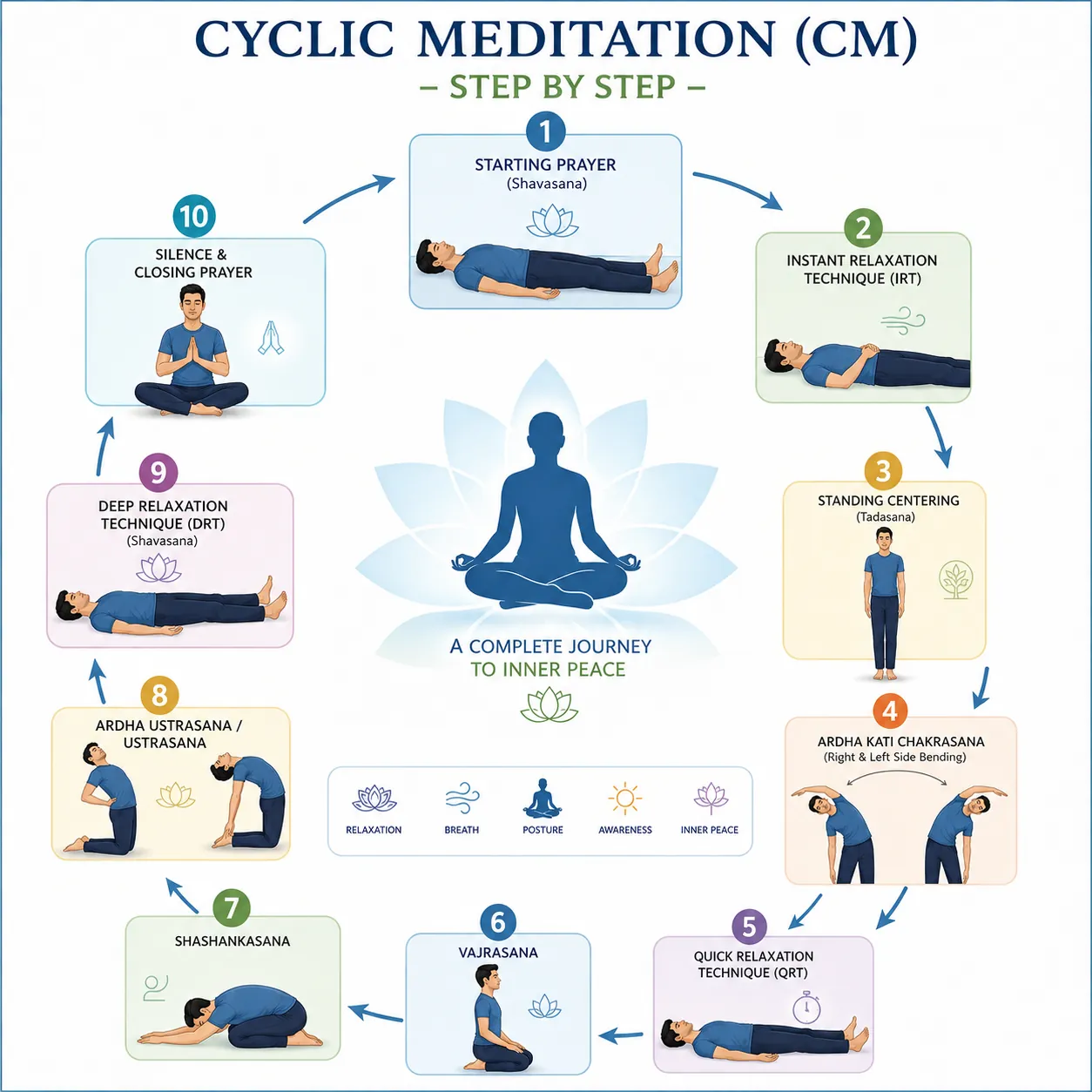
Unlike a static hold in Savasana, CM moves the body through standing and sitting postures and drops it back into rest between each one. That cycle of stimulate → relax → stimulate → relax is the whole idea: physical activity raises the body’s arousal just enough that the relaxation which follows goes deeper than it would on its own. Seven steps, roughly 30–35 minutes, done lying on your back on a mat, in loose clothing, on an empty stomach.
What the research actually shows
CM is one of the more studied yoga-based protocols. A few consistent findings from work carried out at SVYASA’s Center for Advanced Research in Yoga and Neurophysiology:
Autonomic balance
Heart-rate variability studies found CM shifts the nervous system toward parasympathetic (“rest and digest”) dominance more effectively than plain supine rest — higher HF power, lower LF power.
Lower stress hormones
Trials measuring salivary and blood cortisol after CM sessions recorded meaningful reductions, supporting its use as a fast-acting stress-management tool.
Better sleep architecture
Whole-night polysomnography showed more slow-wave sleep on nights following a day of CM practice, compared to nights following equal-length supine rest.
Sharper attention
Letter-cancellation and P300 auditory tasks performed after CM showed improved selective attention and discrimination — likely linked to proprioceptive input during the asanas.
Sources: Telles & Subramanya, A review of the scientific studies on cyclic meditation, Int J Yoga; SVYASA Center for Advanced Research in Yoga and Neurophysiology, Bangalore.
Starting Prayer
Lie on your back and let the whole body collapse onto the ground — legs apart, arms apart, palms facing up, a soft smile on the face. Let go of every part of the body. As you repeat the prayer, feel it resonate through you.
Laye Sambodhayet Cittam Viksiptam Samayet Punah
Sakasayam Vijaniyat Samapraptam Na Calayet
Meaning: In the state of oblivion, awaken the mind; when agitated, pacify it; know the mind when tinged with desire; and once it has reached perfect equilibrium, do not disturb it again.
Instant Relaxation, Linear Awareness & Centring
II(a) — Instant Relaxation Technique (IRT)
Bring the legs together, heels and toes touching, palms by the thighs, face smiling throughout. Bring awareness to the toes: stretch them, tighten the ankles, calves, kneecaps, thighs. Squeeze the buttocks, suck in the abdomen, make fists and tighten the arms. Inhale, expand the chest, tighten the shoulders, neck and face — the entire body from toes to head. Tighten, tighten, tighten… then release. Legs apart, arms apart, palms up. Let every group of muscles fall and sink. Collapse the whole body. Enjoy the relaxation.
II(b) — Linear Awareness
Raise the left arm overhead along the ground and roll onto the left side — head on the left biceps, right leg over the left, right palm on the right thigh. Feel the entire weight of the body settle along the left side of the trunk. Slowly rise to standing (Tadasana), movements slow, breath deep and continuous, eyes closed. Notice the blood flow, the heartbeat, the pulse as you reach vertical. Chant Bhramari — a humming “NNN” — and feel the whole body resonate with it.
II(c) — Centring
Lean forward — feel the weight on the toes, a pointed awareness. Lean back — weight on the heels, a surface awareness. Return to center. Lean right, then left, noticing the weight shift along the edges of the feet each time. Come back to center: weight distributed evenly across both soles, shoulders collapsed, arms hanging freely, face smiling. Notice everything that has changed in the body.
Standing Asana — Ardha Kati Cakrasana
The first round of stimulation and relaxation: Ardha Kati Cakrasana, the half-wheel posture, worked one side at a time.
Raise the right arm sideways, slow and continuous, to horizontal — twist the palm at the wrist as it passes 90°, a pointed awareness there. Glide on to 135°, then fully vertical, biceps grazing the right ear — a broad, surface awareness in the shoulder. Stretch from the fingertips through the whole right side of the body; keep the face relaxed and smiling throughout, even as everything else stretches. Bend slowly to the left, left palm sliding down the left thigh, feeling the waist stretch on the right and compress on the left. Return to vertical, stretch up once more, then lower the arm back down through 135°, horizontal (palm turning down at the wrist), 45°, and finally let it hang by the thigh. Notice the right side of the body — charged, light, energized.
Mirror the whole sequence on the left side — left arm up through 45°, 90°, 135°, vertical, bend to the right, return, lower back down — until both sides feel equally alive.
Quick Relaxation Technique (QRT)
Sit down and lower into Savasana from the right side — right arm stretched, head on the right biceps, left leg over the right, weight transferring to the ground, a sharp linear awareness. Roll onto the back, arms and legs apart, palms up. Settle into three breathing phases:
Watch the abdomen rise and fall naturally, without manipulating the breath. Five rounds.
Sync the movement with breath — abdomen rising on inhale, sinking on exhale. Five rounds.
Inhale — feel the body energize and lighten. Exhale — feel it collapse, sink, release all tension. Five rounds.
Bring the legs together, hands by the sides, and come up to a seated Dandasana with the support of the elbows — legs stretched out, palms behind you for support, neck relaxed and head hanging freely or resting on a shoulder.
Sitting Asanas — Vajrasana, Sasankasana & Ustrasana
Vajrasana
Fold the right leg back, then the left, sitting onto the heels. Palms on the thighs, spine erect. Notice the balance, the quiet harmony of the posture.
Sasankasana
Take the arms behind and hold the right wrist with the left palm — feel the pulse, the heartbeat. Bend forward, chest and abdomen pressing the thighs, and let the forehead rest on the ground. Shoulders collapse. Inhale and chant M-kara — “MMM” — feeling it resonate through the head. Rise back to Vajrasana slowly, noting the lightness returning.
Ustrasana
Rise onto the knees for Ardha-Ustrasana, palms sliding up to support the lower back, fingers pointing forward. Lean back from the waist, neck relaxed, head hanging freely — a deep stretch through the abdomen and chest. If it’s comfortable, go further into full Ustrasana, hands reaching the soles of the feet. Inhale and chant “AAA.” Return slowly to Vajrasana, then release the legs into a seated, legs-stretched position.
Deep Relaxation Technique (DRT)
Slide back down to Savasana with the support of the elbows. Legs apart, arms apart, palms facing the roof. Let the whole body collapse into the ground. This is the longest and deepest rest of the practice — make yourself completely comfortable, and let go.
Closing Prayer
Sarve bhavantu sukhinah, Sarve santu niramayah
Sarve bhadrani pasyantu, Ma Kascit duhkha bhagbhavet
Meaning: May all beings be happy, may all be free from illness. May all see what is auspicious, may no one suffer.
Practice it with guidance, not just a page.
Yognic runs live online yoga classes where Cyclic Meditation and other SVYASA-based protocols are taught step by step, with real-time correction. Reach out to join a session.