Sukshma Vyayama Yoga
Sukshma Vyayama: the quiet loosening that unlocks your yoga practice
Before the first Sun Salutation, before the deep stretch — there is a simpler, older practice. A few minutes of small, mindful movements at every joint that clear the stiffness modern life quietly deposits in the body.
Hope this note finds you well. Today let’s talk about Sukshma Vyayama — the subtle, joint-by-joint warm-up that yoga considers one of the most important preparations of all.
Classical yoga teaches that the earliest blockages in the body’s pranic flow appear at the joints. Ayurveda mirrors this: uric acid and other metabolic acids the body cannot flush quietly settle into the same places — knees, wrists, shoulders, spine. First they cause stiffness. Then pain. Given enough time, they seed the chronic aches we later label as disease.
Sukshma Vyayama is the antidote. It is small in motion but powerful in effect, because it works directly on the sukshma (subtle) pranic body — the layer that circulates energy through every joint before muscles even engage.
“The best way to care for your joints is to mindfully keep changing their state — a little, often.”
What Sukshma Vyayama actually does
Every joint is a small hinge of synovial fluid, cartilage, ligament and nerve. When we sit at desks, scroll on phones, or repeat the same three or four postures all day, that fluid stops circulating. The joint dries. The nerve signal dulls. Prana, in yogic language, gets stuck.
Sukshma Vyayama moves the fluid. It wakes the nerve. It sends a gentle “you are still alive here” signal to parts of the body we routinely forget. Do it before any yoga practice — or first thing in the morning — and everything that follows becomes safer and deeper.
- Joint mobility improves in weeks, not months. A 2015 review in the International Journal of Yoga found that gentle joint-mobilisation routines like Sukshma Vyayama significantly improved range of motion and reduced stiffness in adults after just 4–6 weeks of daily practice.
- Better circulation, lower resting heart rate. Studies from SVYASA (Bengaluru) have shown that 15 minutes of subtle-body warm-ups measurably improves peripheral blood flow and lowers resting heart rate — comparable to a light aerobic warm-up but with far less effort.
- Lower inflammation markers. Research on gentle daily movement (including yogic mobility work) has linked it to reduced serum uric acid and C-reactive protein levels — supporting the Ayurvedic view that stagnation at the joints is a driver of inflammation.
- Mood and cognitive clarity. A 2019 study in Frontiers in Human Neuroscience reported that short, mindful movement sequences done in the morning improved attention, mood, and working memory for the rest of the day.
The benefits, simply
A few minutes of Sukshma Vyayama, done daily and done mindfully, does this:
How to practise
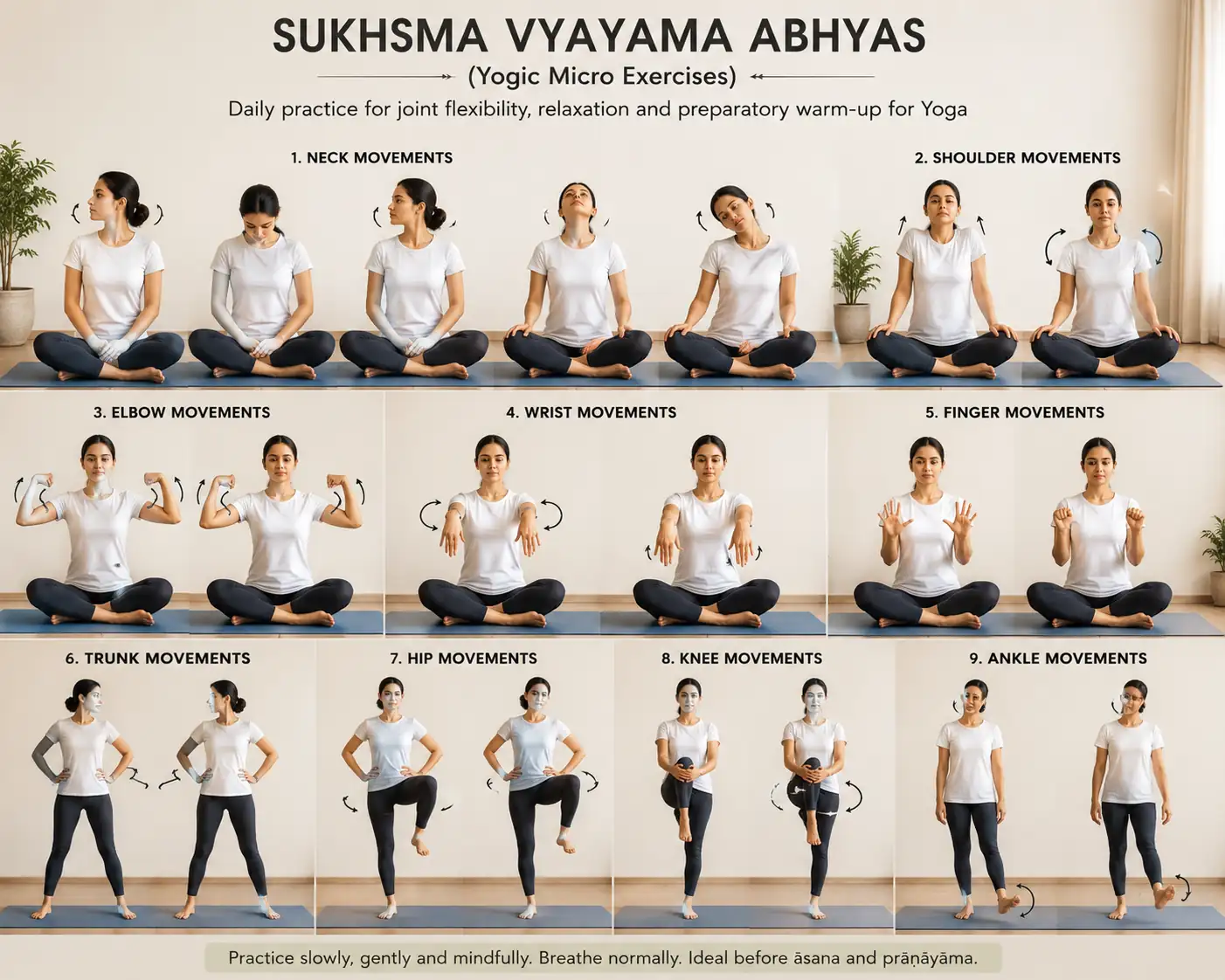
Sit comfortably — on a chair or on the floor. Spine tall, shoulders soft. Begin at the crown of the head and travel downward, giving each joint 8–10 gentle rotations or movements: eyes, jaw, neck, shoulders, elbows, wrists, fingers, waist, hips, knees, ankles, toes.
Do it slowly. Do it with attention. That attention is not a nice extra — it is the practice. Rushed rotations are just calisthenics. Mindful rotations are Sukshma Vyayama.
Ten minutes is plenty. Do it before any yoga session — always — and, if you can, once again mid-afternoon when the body starts to congeal at the desk.
The small habit that changes everything
Most people wait until pain arrives to think about their joints. Sukshma Vyayama is the opposite instinct — a small, boring, daily kindness the body will quietly repay for decades.
Make yoga part of your daily life. Stay well. Stay curious about what your own body is telling you.
Join our online yoga classes.
Live sessions of Sukshma Vyayama, Hatha Yoga, Pranayama and guided meditation — from anywhere in the world. Small groups. Real teachers. Real transformation.
Thank you for your precious time.
May you stay happy, and stay well.