Tadasana
Tadasana (Mountain Pose): The Foundation Every Standing Yoga Posture Is Built On
It looks like standing still. It is actually the most instructive posture in your entire practice — the one that teaches your feet, spine, shoulders and mind to work as one.
Friends, yoga is pure science — the science of your body, the science of your mind, and the science of right living. Every time you step onto the mat, the posture in front of you deserves more than a passing performance. It deserves depth.
That depth only arrives when you understand what the pose is actually doing — which muscles it engages, how your breath and mind respond to it. Simply jumping from one asana to the next without knowing the science behind it isn’t yoga. It’s just exercise wearing yoga’s clothes. For a posture to be Yoga, your mind and your body must both be present, together, in it.
So let’s come back to today’s asana — Tadasana, the Mountain Pose, also known as Palm Tree Pose. It is the most basic standing posture in yogasana, and everything else you’ll ever stand into begins here.
- 01 How to actually do Tadasana, step by step
- 02 The real benefits of Tadasana — beyond posture
- 03 The anatomy at work behind this “simple” pose
- 04 How to use it to correct a slouched back and rounded shoulders
What is Tadasana, and why start here?
Tada means mountain — in some lineages, palm tree — and asana means pose. Together, Tadasana is the posture of standing steady, tall and grounded, like a mountain that doesn’t waver. It’s a beginner’s pose in the sense that anyone can attempt it, but it is not a beginner’s achievement to actually do it well. Underneath its stillness, your feet, legs, spine and shoulders are all quietly working.
How to do Tadasana
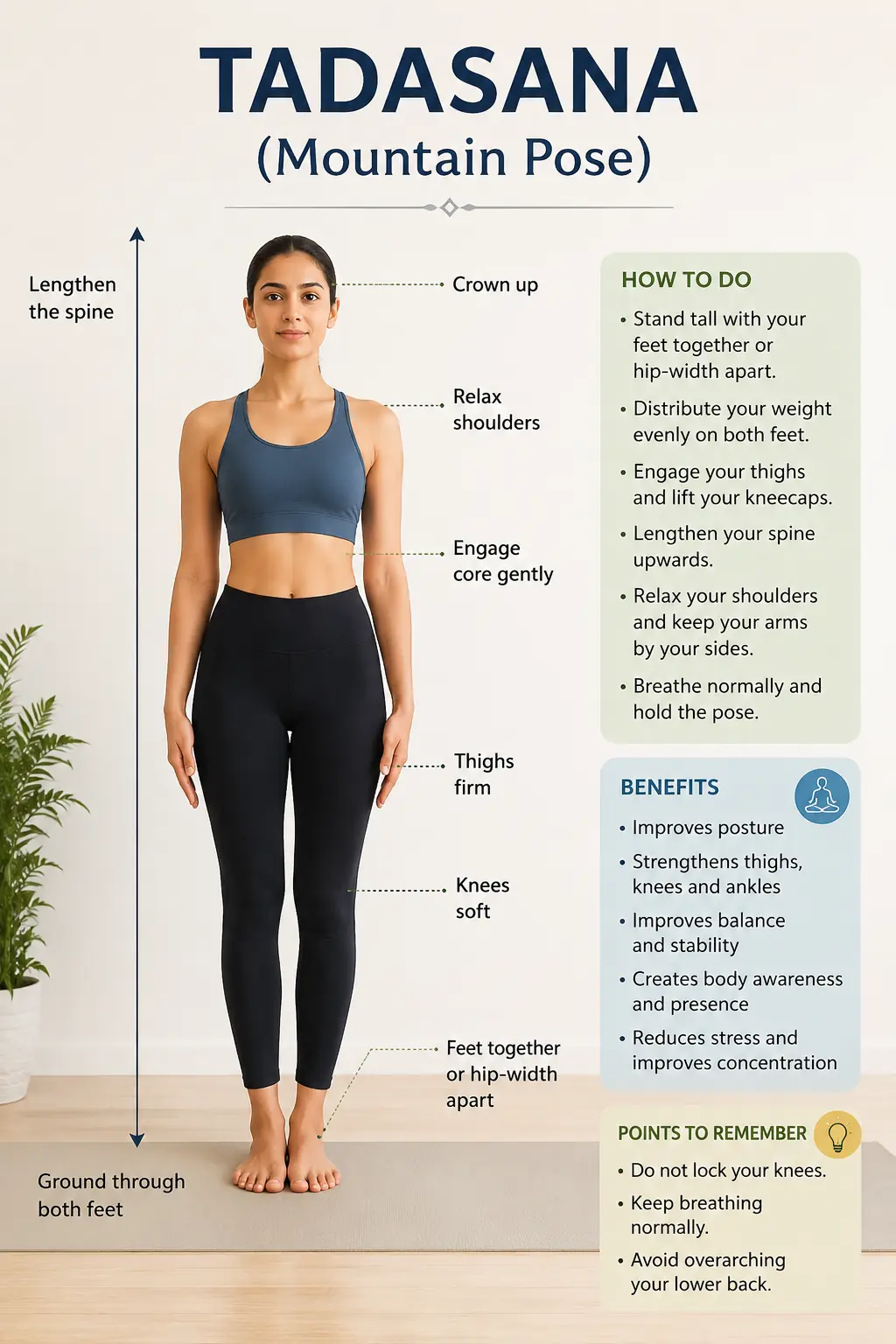
- Stand with your big toes touching, heels slightly apart. Spread your toes wide and root all four corners of each foot evenly into the floor.
- Lift your kneecaps gently by engaging the thighs, without locking the knees.
- Draw your tailbone slightly in, lengthen the lower back, and lift through the crown of your head — ankles, knees, hips, shoulders and ears stacked in one straight line.
- Roll your shoulders back and down, away from your ears, and let your chest open without pushing the ribs forward.
- Let your arms rest by your sides, palms facing forward, fingers relaxed and long.
- Soften your gaze, breathe slowly and evenly, and hold for 30 seconds to a minute — present in the body, not just standing in it.
That’s the shape. But the shape is only the beginning — the science is in why each of these actions matters.
The anatomy behind Tadasana
This is where “just standing” becomes yoga. In Tadasana:
- Feet and arches — the intrinsic muscles of the feet activate to distribute weight evenly, building the base every other standing pose depends on.
- Quadriceps and glutes — engage to lift the kneecaps and stabilise the pelvis over the ankles.
- Core and lower back — the transverse abdominis and erector spinae co-contract to hold the spine’s natural curves without collapsing or over-arching.
- Upper back and shoulder girdle — the rhomboids and lower trapezius draw the shoulder blades down and back, directly counteracting the forward-rounded posture most of us carry from desks and phones.
- Neck and gaze — a lifted crown and soft, level gaze train the deep neck flexors instead of letting the head jut forward.
None of this is visible from the outside. That’s exactly why understanding the anatomy changes the pose — once you know which muscle should be doing the work, you stop merely standing and start practising.
Correcting a slouched back and rounded shoulders
Most of us don’t slouch because we’re lazy — we slouch because our postural muscles have forgotten their job. Tadasana retrains them, deliberately:
- Instead of pulling your shoulders back forcefully, roll them up, back and down — this activates the lower trapezius rather than just the neck and traps.
- Stop the ribs from flaring forward; keep them stacked directly over the pelvis so the lower back doesn’t over-arch.
- Practise Tadasana against a wall for a few breaths — heels, hips, shoulder blades and back of the head all lightly touching — to feel what a truly neutral spine feels like.
- Repeat this daily. Posture is a habit before it’s a shape — a few honest minutes in Tadasana each day retrains the habit.
Benefits of Tadasana
- Corrects posture — this is the big one. Tadasana is one of the most direct tools yoga gives you for undoing years of slouching.
- Excellent for kids — practised young, it builds body awareness and good standing habits before poor posture ever sets in.
- Builds balance and body awareness — by training even weight distribution through the feet and legs.
- Calms the mind — a grounded, still body gives the mind a place to settle, making it a natural pause between more active postures.
- Prepares you for every standing pose — Warrior, Triangle, Tree — all of them borrow their alignment from Tadasana.
What research says
A cross-sectional study comparing regular yoga practitioners to non-practitioners found measurably reduced excessive thoracic kyphosis (upper-back rounding) and lumbar lordosis, pointing to real, structural improvements in spinal posture from sustained asana practice.
Clinical reviewers note that grounding, alignment-focused poses like Mountain Pose can improve balance and reduce fall risk, an effect considered especially valuable with age.
A systematic review of yoga’s effect on proprioception — the body’s sense of its own position — found a consistent positive direction across the available studies, supporting the idea that standing postures sharpen the body’s internal feedback system, even though researchers note more pose-specific research is still needed.
A neurophysiology review describes how holding a stable, conscious posture sends proprioceptive signals up the spinal cord toward the brain, and links regular asana practice to better balance between the nervous and endocrine systems — a scientific echo of what yogis have long called steadiness of body and mind together.
This is exactly the science we mean when we say go deeper into the posture — understand what’s happening in the body, and the pose stops being a shape and starts being yoga.
A closing note
You’ll find many other ways to teach and practise Tadasana out there — I won’t say any of them are wrong. But I can promise you this: what I’ve taught you here, practised regularly and with attention, will benefit you. Yoga rewards consistency far more than it rewards variation.
Join Yognic’s online yoga classes and learn standing postures like Tadasana the right way — with correct alignment, real anatomy, and a teacher who can see and correct you, live.