
Yoga for fertility
Yoga for Fertility: What Actually Helps, and What Doesn’t
Trying to conceive can turn your body into a project and every month into a verdict. This week we talk about what yoga can genuinely do for fertility, the three areas it works on, the daily basics your body needs, a gentle 20-minute sequence, and what the research really says.
“We have done the tests, we are doing everything right, and everyone just tells us to relax.” Couples say some version of this to me again and again.
Yoga is support, not a cure
Let me be straight with you first. Yoga does not fix blocked tubes, low sperm count, PCOS, endometriosis or age-related changes. Anyone who promises that is selling you something.
What yoga can do is work on everything around those things: your stress load, your sleep, your circulation, your relationship with your own body, and the daily habits that quietly shape your hormones. Those matter, and they are the part you can actually control.
Fertility is also never one person’s job. In a large share of couples who struggle to conceive, male factors are involved, so this practice is just as useful for him as for her.
Three Areas Yoga Works On
A good fertility practice is not about twisting yourself into shapes. It supports three things, in this order.
A Calmer Nervous System
Months of waiting, tests and well-meaning questions keep the body in a constant alert state. Slow breathing, restorative poses and yoga nidra help move you out of it. This is where yoga has its strongest support.
Gentle Pelvic Circulation
Hip-opening and supine poses ease stiffness in the lower back, hips and pelvic floor, and encourage comfortable movement through the pelvic region. The benefit is comfort and body awareness; it is not a proven way to improve egg or sperm quality.
A Steadier Daily Rhythm
A regular practice pulls the rest of your day into order: fixed sleep, sattvic food, less alcohol and caffeine, no crash dieting, no over-training. These habits do more for hormonal balance than any single pose.
If you only do one thing from this post, make it the first: calm the body down before you try to fix it.
The Basics Your Body Needs
Four numbers worth knowing if you are planning a pregnancy. Your own doctor may adjust them for your health and history.
Standard advice for anyone trying to conceive. Ask your doctor about the right dose for you.
Poor and irregular sleep disturbs the hormones that regulate your cycle
Consistency beats intensity. Skip hot yoga and punishing workouts
After 12 months if under 35, after 6 months if 35 or older. Sooner if you have known issues
A Gentle 20-Minute Fertility Sequence
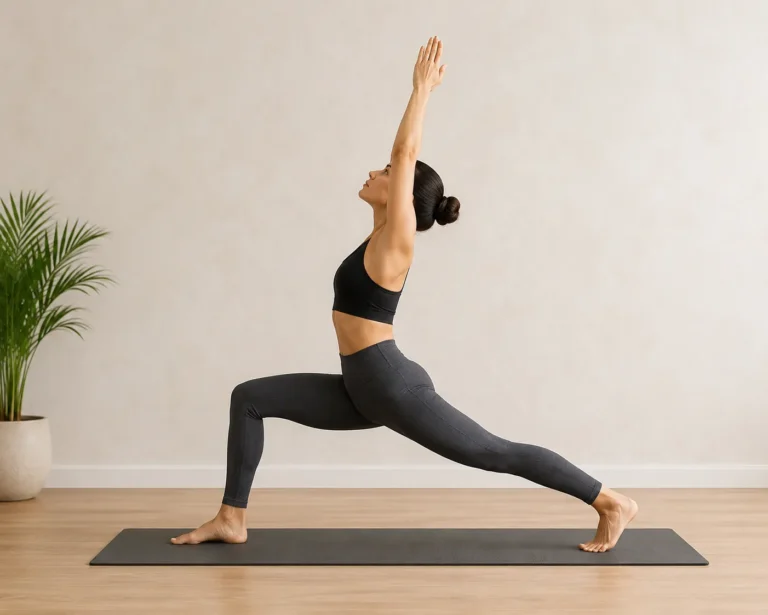
Nothing here needs flexibility or experience. Practise on an empty stomach or at least two hours after a meal, with slow nasal breathing throughout.
Knees wide, forehead down. Settle the breath first.
Move with your breath to loosen the spine and lower back.
Soles together, spine tall. Do not push the knees down.
Three rounds of 30 seconds, lifting only as high as feels easy.
Support both knees with cushions. Hands on the lower belly.
Hips near the wall, legs resting. A bolster is optional.
Alternate-nostril breathing, then humming breath. Gentle, no forced holds.
Go easy on: hot yoga, strong inversions, fast vinyasa flows and forceful breathing like kapalabhati. If you are undergoing IVF or IUI, or have had an embryo transfer, check with your fertility doctor before choosing your practice.
Promising, Not Proven
Mind-Body Programmes
Research led by Dr. Alice Domar at Harvard-affiliated hospitals found that women in a mind-body programme that included yoga and relaxation had higher pregnancy rates than women who got no support. The studies were small, so treat this as encouraging, not conclusive.
Yoga and IVF Stress
Small trials of women going through IVF show that yoga can lower anxiety and stress during treatment. Whether that raises the chance of pregnancy is still an open question, but going through treatment with less distress is a worthwhile result on its own.
Nurses’ Health Study II
A long-running Harvard study following thousands of women found that healthy weight, regular moderate exercise and a diet rich in plants, whole grains and good fats were linked to a lower risk of ovulatory infertility. This is about lifestyle as a whole, and not yoga alone.
The honest summary: yoga reliably helps with stress, sleep and well-being, and those are good for fertility. It works best alongside medical care, not instead of it.
Be patient with your body. It is not failing you, and it does not need to be punished into working.
Calm the body. Support the cycle. Keep the faith.
Join live personal online yoga classes
Reading about yoga is a start, but practising with a teacher who can see you makes the difference. In our live, personal online classes, your instructor works with you one-on-one, adjusts the practice to your body, your cycle and your comfort level, and corrects your posture and breathing as you go. Join from your own living room, at a time that suits you, and build a routine you can actually keep.
This article is for general education and is not medical advice. If you have been trying to conceive for a while, or have a known condition, please speak with a qualified doctor.
Wishing you good health and happiness. Hari Om. 🙏