Pranayama Part 1
Pranayama for Beginners: Kapalbhati, Surya Bhedi & Chandra Bhedi Explained
A practical, step-by-step guide to three foundational breathing practices from Maharishi Patanjali’s Ashtanga Yoga — how to do them, who should avoid them, and what research says about their benefits.
Before we practice, it’s worth understanding what pranayama actually is. Maharishi Patanjali, the sage credited with systematizing yoga, described eight limbs of practice in the Yoga Sutras: Yama, Niyama, Asana, Pranayama, Pratyahara, Dharana, Dhyana and Samadhi — together known as Ashtanga Yoga. Pranayama is the fourth limb.
The word itself is a combination of two Sanskrit roots — prana, meaning life force or vital energy (closely tied to the breath), and ayama, meaning extension or expansion. So pranayama, in essence, is the practice of extending and regulating the breath to expand the body’s vital energy.
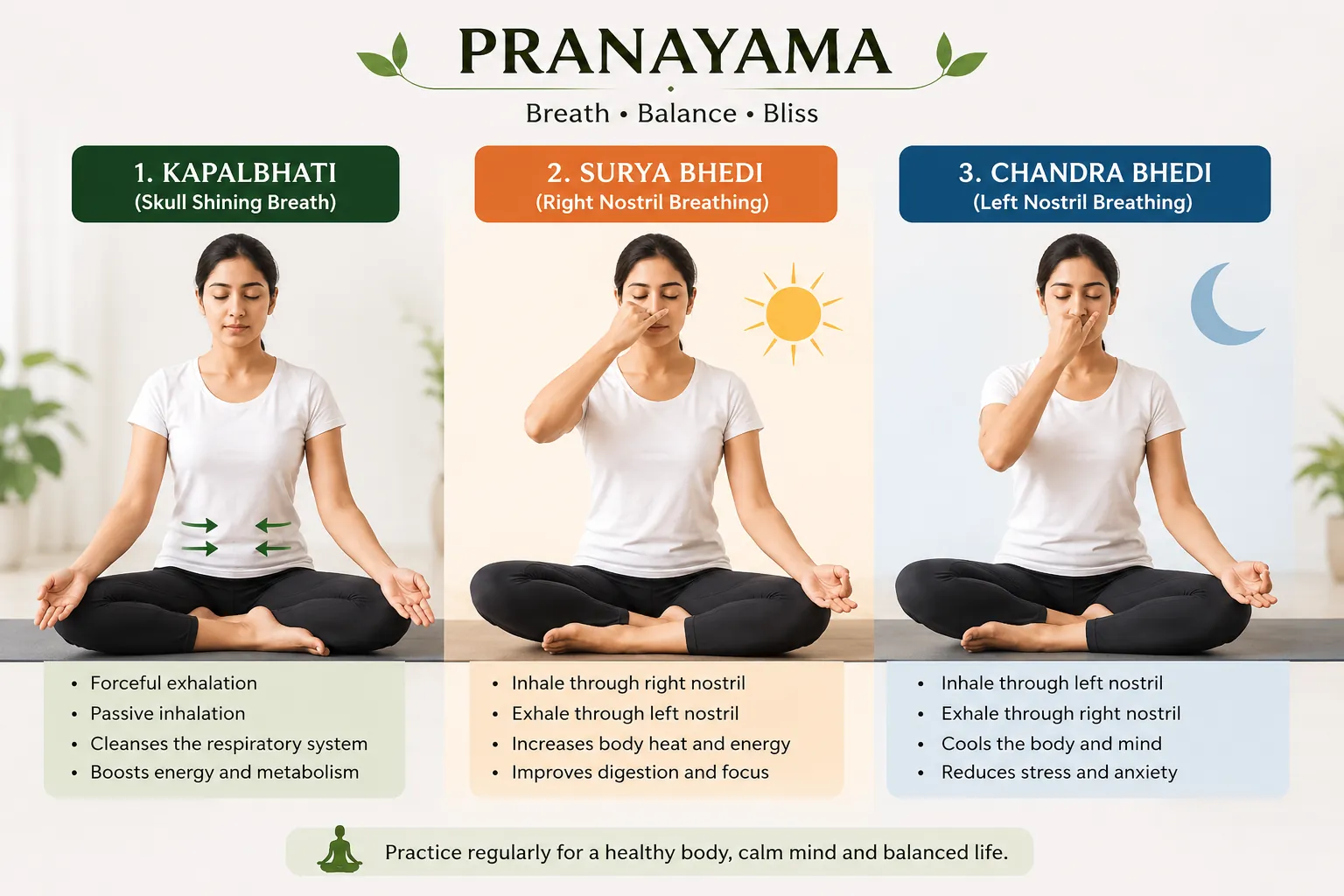
There are many pranayama techniques. This guide covers three you can start practicing today: Kapalbhati, Surya Bhedi (with Surya Anulom Vilom), and Chandra Bhedi (with Chandra Anulom Vilom).
A quick word of caution
Never experiment with pranayama on your own if a step feels unclear. Practicing incorrectly can carry adverse effects. Learn from an experienced teacher, or drop a comment below with your question.
1. Kapalbhati Pranayama
Kapalbhati is sometimes classified as a shatkarma (cleansing technique) and elsewhere taught as a pranayama in its own right. The name comes from two words: kapal (skull / forehead) and bhati (shine, glow) — together, “the practice that brings a glow to the face.”
How to practice
- Sit in any comfortable meditation posture — Sukhasana, Padmasana, or Siddhasana. If sitting on the floor isn’t possible, a chair works just as well.
- Keep your spine and neck upright throughout, eyes gently closed.
- Rest your hands in Chin Mudra on your knees — the mudra helps sustain awareness through the practice.
- Exhale forcefully and rapidly through the nose (active exhalation), pulling the navel firmly in and back toward the spine.
- Release the abdominal muscles and let the inhalation happen on its own, passively — you don’t actively pull air in.
- Keep your attention on the exhalation. This is the active, effortful part of the cycle.
Keep your facial muscles relaxed — a common mistake is tensing or scrunching the face while pumping the breath. There should be no strain in the jaw, brows, or eyes.
Pace & rounds
Beginners: 40–60 strokes per minute, 3 rounds a day minimum. Rest 15–20 seconds between rounds, breathing normally — increase strokes and rounds gradually with daily practice.
In the gap
The 15–20 second pause after each round often brings a few seconds of deep stillness. Notice whatever arises there — it deepens with regular practice.
Benefits
Physical: brings a natural glow to the face, clears sluggishness and lethargy, gives the abdominal organs a gentle internal massage, and strengthens and cleanses the lungs and respiratory tract — genuinely helpful for those managing asthma or other breathing-related conditions.
Spiritual/mental: sharpens concentration and calms the mind, which in turn makes meditation easier to access.
Who should avoid it
Skip Kapalbhati if you have high blood pressure, heart disease, hernia, gastric ulcers, or a slipped disc. Women should avoid it during pregnancy and menstruation.
2. Surya Bhedi Pranayama & Surya Anulom Vilom
As with Kapalbhati, sit in any meditation posture or on a chair, keeping your spine and neck straight.
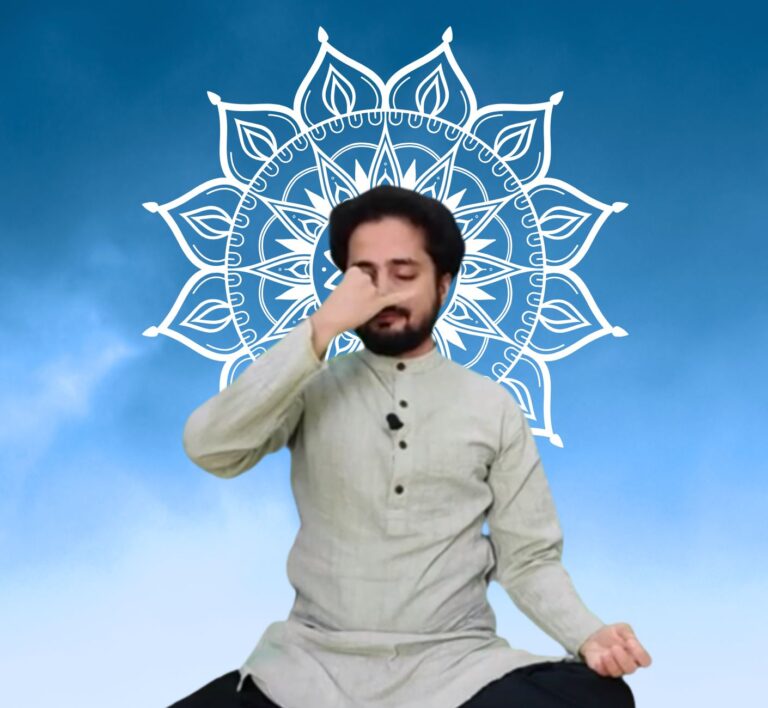
- Bring your right hand into Nasika Mudra (nostril-closing hand position). The left hand can rest skyward or in Chin Mudra.
- Close the left nostril with your ring finger and inhale deeply and slowly through the right nostril only.
- Keep the breath slow and gentle, just like a normal breath — never fast or forceful.
- The left nostril stays closed throughout; inhale and exhale, deep and long, only through the right. One full inhale-exhale is one round.
Beginners should aim for at least 9 rounds, increasing gradually with daily practice.
Benefits: supports weight management and is considered helpful for people dealing with low mood or depression; also helps clear the nasal passages.
Who should avoid it: people with high blood pressure, heart disease, or a low body weight.
3. Chandra Bhedi Pranayama & Chandra Anulom Vilom
The mirror image of Surya Bhedi: keep the right nostril closed throughout and breathe only through the left. Everything else follows the same rhythm — slow, deep, unforced. Start with 9 rounds and build up gradually.
Benefits: considered supportive for those with a low body weight looking to gain weight, and works well for easing anxiety. Those who are overweight should skip this one.
What the research says
Pranayama’s effects are increasingly backed by clinical research
1. Blood pressure: A systematic review and meta-analysis found that breathing exercises including pranayama can modestly but significantly lower both systolic and diastolic blood pressure in people with hypertension.
2. Heart rate & autonomic balance: Studies on Nadi Shodhana (alternate nostril breathing) report reductions in systolic and diastolic blood pressure and heart rate, attributed to its stress-reducing, parasympathetic-activating effect.
3. Stress and mood: Controlled trials on yogic breathing show reduced perceived stress, improved mood, and lower cortisol and cardiovascular reactivity to stress in both healthy and clinical populations.
4. Accessibility: One randomized trial found guided video-based yogic breathing instruction worked as well as in-person classes for lowering blood pressure — good news for anyone practicing from home via online yoga classes.
Sources: systematic reviews and RCTs indexed in PubMed/PMC and Hypertension (AHA Journals), 2018–2026. Pranayama is a complementary practice — always continue prescribed medication and consult your physician for any medical condition.
Why practice pranayama daily
- Improves circulation throughout the body
- Strengthens immunity and disease resistance
- Supports a healthier, more radiant appearance and greater overall vitality
A few things to keep in mind
- Early morning is considered the most beneficial time to practice.
- Never experiment or improvise with pranayama technique on your own.
- If any step is unclear, ask an experienced teacher before attempting it — done incorrectly, pranayama can cause harm.
- Practice in a well-ventilated room with doors and windows open, never in a sealed space.
That’s Pranayama, Part 1 — Kapalbhati, Surya Bhedi, and Chandra Bhedi. A few more essential practices are coming in Pranayama Part 2. Thank you for your time. Please like this post, subscribe, and stay well.
Har Om.
Learn With Guidance
Join Yognic’s Online Yoga Classes
Learn pranayama, breathing exercises, and yoga for beginners the right way — live, guided online yoga classes so you never have to guess at technique.