Online Yoga class Benefits
Online Yoga Classes: The Quiet Revolution Reshaping How India Rolls Out the Mat
Live teachers. Living rooms. Real transformation. Here’s why online yoga has quietly become the most sustainable wellness habit of the decade — and how to make it work for you.
There’s a particular kind of stillness that used to belong only to ashrams and early-morning parks — the sound of breath moving in a quiet room, a teacher’s voice guiding you deeper into a pose. For most working Indians, that stillness felt geographically inconvenient. You either lived near a good studio, or you didn’t practise.
Then something shifted. The mat moved indoors. The teacher moved onto a screen. And a practice that is 5,000 years old finally met the one modern constraint it had been struggling with: time.
Online yoga classes are no longer a pandemic-era compromise. They are, for a growing share of practitioners, the preferred way to practise — and the data backs the feeling.
What the research actually says
Four findings worth knowing before you unroll a mat at home.
Online yoga measurably improves stress and sleep
A 2022 systematic review published in the Journal of Medical Internet Research examined virtual yoga interventions and found statistically significant reductions in perceived stress, anxiety, and sleep disturbance — with adherence rates comparable to in-person classes.
People stick with home practice longer
Harvard Medical School’s Osher Center reported that participants in remote yoga programs maintained practice 30–40% longer than studio-only groups, largely because eliminating commute time removed the single biggest reason people quit.
It works clinically, not just casually
A randomized trial in JAMA Network Open (2023) found that 12 weeks of live-streamed yoga reduced systolic blood pressure and lowered HbA1c in adults with type 2 diabetes — comparable to outcomes from in-person therapeutic yoga.
The Indian wellness market is voting with its wallet
According to a 2024 FICCI–EY wellness report, India’s online yoga and meditation segment is growing at roughly 22% CAGR — outpacing gyms, fitness apps, and physical yoga studios combined. Live, teacher-led sessions are the fastest-growing sub-category.
Why the living room beats the studio
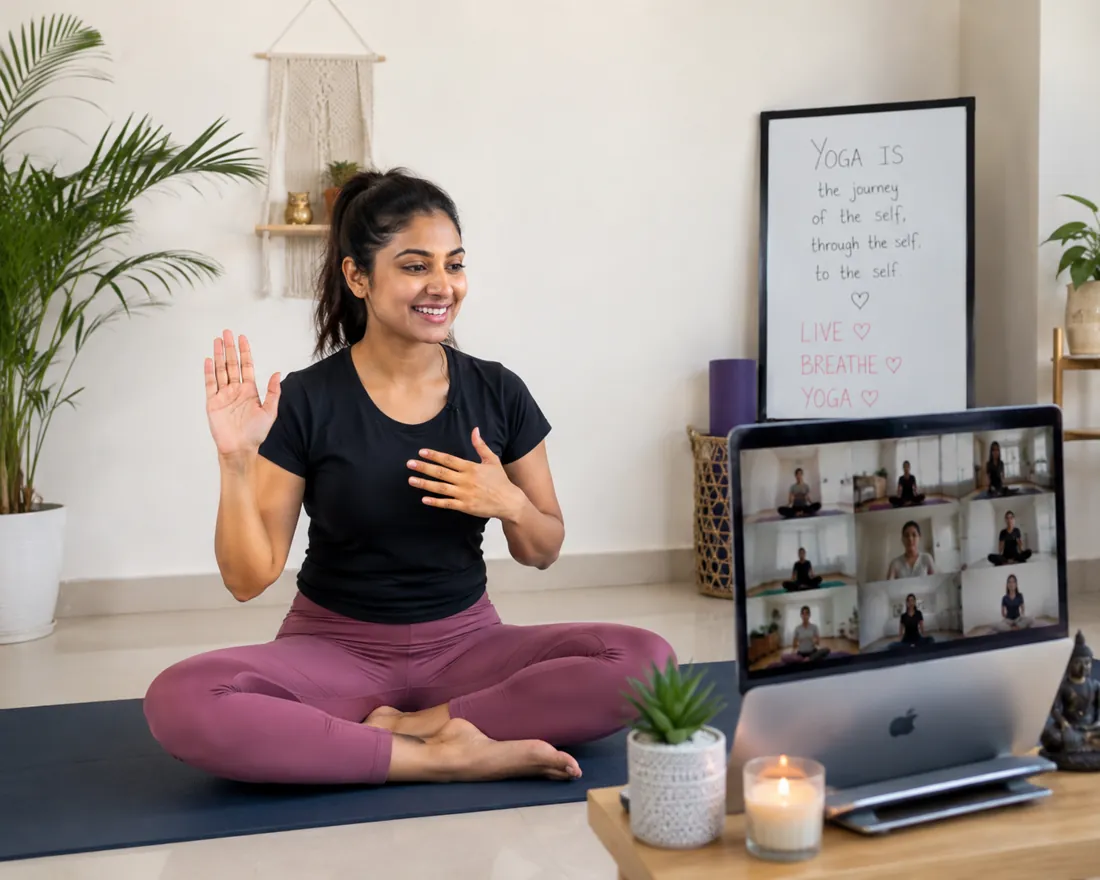
The old assumption was that a screen would dilute the experience. In practice, the opposite happens. When your teacher is looking directly at the camera and correcting your Trikonasana by name, the intimacy is often greater than being one of thirty mats in a hall.
The other quiet advantage: consistency. A 6 AM class is genuinely doable when it starts three feet from your bed. You practise on days you would otherwise have skipped — through Delhi traffic, Bangalore rain, a Bombay deadline. Over a year, those “would-have-skipped” days are where the transformation happens.
And critically — you can practise with a certified teacher from Rishikesh while sitting in Gurgaon, Chennai, or Chicago. Geography stops being a filter for lineage.
“The best yoga class is the one you actually attend. Online removed the single biggest obstacle — getting there.”
How to choose an online yoga class that actually sticks
Not every stream is created equal. A pre-recorded YouTube flow is not the same as a live, guided class with a teacher who knows your knee. When you evaluate an online yoga program, look for:
- ✦Live sessions, not just video libraries. Real-time correction is what prevents injury and builds real posture.
- ✦Small batch sizes. If the teacher can’t see you, they can’t teach you. Look for classes under 15 students.
- ✦Certified teachers with traditional training. Ideally Yoga Alliance registered, ideally with roots in a genuine Indian lineage.
- ✦A trial class. You should never pay for a subscription before you’ve breathed with the teacher once.
- ✦Flexible timings across the day. Especially if you work shifts or travel.
Who online yoga is really for
The audience isn’t who you think. It isn’t primarily the flexible, the young, or the already-well. The people who benefit most from online yoga classes are:
Working professionals with back pain from twelve hours at a desk. New parents who can’t leave a sleeping child. Seniors for whom driving to a studio is itself the barrier. People managing chronic conditions — hypertension, PCOS, diabetes, anxiety — who need consistent practice more than an occasional intense one.
And, increasingly, the Indian diaspora, who want to learn yoga the way it was taught in India — in Hindi or English, from a teacher who understands both the science and the source.
The practice, not the platform
Yoga was never about the room. It was about the breath, the attention, the willingness to show up. What online classes have done is remove everything between you and the mat — the commute, the parking, the schedule you couldn’t quite make fit.
What’s left is the practice itself. Which is, of course, what it was always supposed to be.
Unroll the mat. Open the laptop. Begin.